The extra cost of deforestation that nobody talks about
When Indonesia's rainforest is cleared for palm oil, CO₂ escapes into the atmosphere. Capturing them is valued at up to $500,000 per hectare.
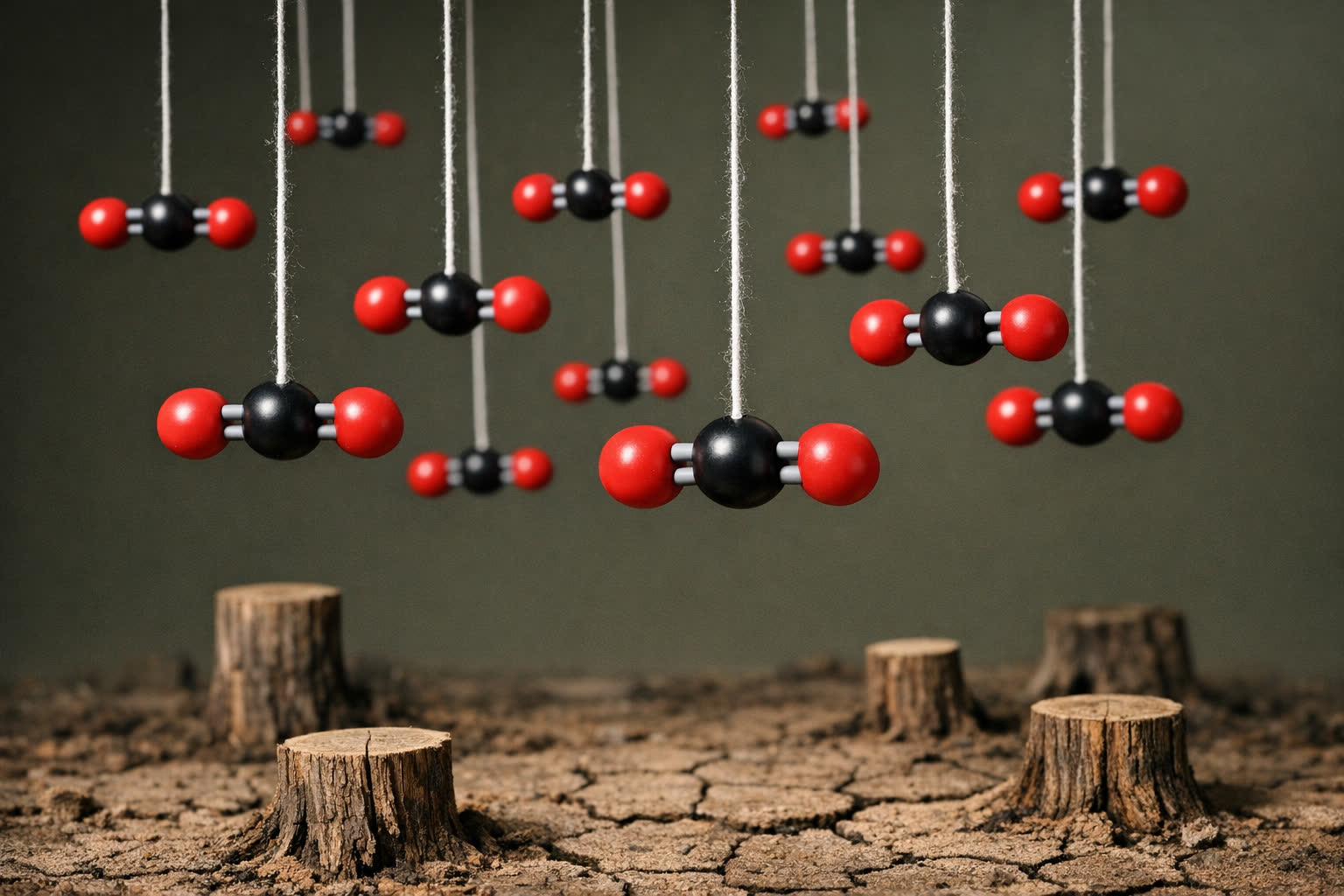
You already know the cost of deforestation. You've probably learned this at school. So, why are we still talking about it even though we already know that it's bad?
One reason is that simply knowing that it's "bad" doesn't help anyone.
Without a number, policymakers can't create fair laws to protect rainforests. "Bad" doesn't help international NGOs put pressure on governments. And it doesn't help you as a voter, because without a number, you can't be informed on what a fair policy looks like.
The goal of this article is to put a number on that missing cost, and we're going to look at this from a perspective you might not have considered yet — carbon emissions.
The extra cost
When a hectare of Sumatran lowland rainforest is cleared, the trees are eventually burned or left to decompose. The carbon that was locked inside these trees for decades are now possibly on their way into the atmosphere, mainly as CO₂ (Climate Council).
Field measurements from Kotowska et al., 2015, who sampled 32 forest and oil palm stands in Sumatra, found that forest biomass holds about 384 Mg per hectare. Oil palm trees that replace the forest trees hold just 50 Mg per hectare. That means a significant chunk of biomass (and the carbon inside it) was removed.
The ICCT (2011) analyzed what happens to cleared forest biomass: about 97% returns to the atmosphere within 30 years, with only ~3% staying in long-lived wood products (timber sold as furniture or construction materials). So the real atmospheric impact over a human generation is roughly 555 tCO₂.
To pull that same carbon back out — using the cheapest available method, which is planting trees — costs $35–65 per tonne of CO₂ (PwC, 2024) — about $19,000–$36,000 per hectare for the 555 tCO₂.
And that is just the start. The rest of this article will explain how this number was derived, and how much more the costs can go up.
The math behind the cost
So where does 555 tonnes per hectare come from? Let's walk through it.
How much carbon per hectare
Kotowska and their team measured 32 plots across Sumatra — half were natural lowland rainforest, half were oil palm plantations. They weighed the trees, and here's what they found:
| Natural forest | Oil palm | Difference | |
|---|---|---|---|
| Tree biomass (Mg/ha) | 384 | 50 | 334 Mg/ha |
| Carbon content (× 0.47 IPCC factor) | ~180 | ~24 | ~156 Mg C/ha |
| CO₂ equivalent | ~660 tCO₂e/ha | ~88 tCO₂e/ha | ~572 tCO₂e/ha |
That 572 is the carbon stock loss from the trees if all the biomass gets burned or decomposed. But not all of it goes to the atmosphere immediately. Some gets sold as timber — furniture, plywood, construction materials — where the carbon stays locked up for years or decades.
The ICCT (2011) analyzed how much of the biomass is converted into wood products. Their finding is quite surprising. Roughly 97% of cleared tropical forest biomass returns to the atmosphere within 30 years, with only about 3% staying in long-lived wood products.
So the real atmospheric impact per hectare: 572 × 0.97 = 555 tCO₂.
That's the number we'll work with.
Losing a free low-maintenance air purifier
Let's not forget that forests don't just store carbon, they also keep absorbing it while they're still alive. Old-growth forests are still actively sequestering carbon, accumulating about 1.2 tCO₂ per hectare per year (Requena Suarez et al., 2019). When you replace that forest with oil palm, that free service stops.
Over 25 years — the typical lifespan of an oil palm cycle — that's 30 tCO₂ of lost future sequestration that nobody accounts for. If we add it up, 555 + 30 = 585 tCO₂ per hectare.
The current President of Indonesia, Prabowo Subianto, confirmed that palm trees are still trees. They absorb carbon dioxide and produce oxygen via photosynthesis. That is technically correct.
The problem with this statement is that oil palm trees do not act the same way as forest trees. The carbon that they store from photosynthesis will eventually be extracted, recycled, and converted into biofuels, and released back into the atmosphere.
The floor price
Now, what does it cost to undo this damage?
The cheapest method available today to remove CO₂ from the atmosphere is afforestation, which is the act of planting trees on land that was previously cleared. A 2024 whitepaper by PwC Indonesia pegs the cost at $35 to $65 per tonne of CO₂ (PwC, 2024).
If we do the multiplication, we arrive at a price figure which we must consider to be impossibly low. It's conservative at best.
| Liability | Quantity | At $35/t | At $65/t |
|---|---|---|---|
| Carbon stock released | 555 tCO₂ | $19,425/ha | $36,075/ha |
| Lost future sequestration (25 yrs) | 30 tCO₂ | $1,050 | $1,950 |
| Total | 585 tCO₂ | $20,475/ha | $38,025/ha |
That's roughly $20,000 to $38,000 per hectare when deforestation happens on regular "mineral" soil.
When deforestation happens on peatland
A huge share of Indonesia's palm expansion actually happens on peat.
Peat is carbon-rich soil, meters deep, that accumulates over thousands of years. When a peat swamp forest is cleared and drained, the same 555 tCO₂ is released from the trees. But the drainage itself adds a second, much larger source of emissions: peat oxidation. Exposed dry peat continuously releases CO₂ every year for decades.
Between 2015 and 2025 alone, Indonesia lost 1.5 million hectares of peat swamp forest (YKAN / Nature Conservancy). Today, 2.2 million hectares of existing palm plantations — about 14% of the total — sit on drained peat (Trase / SEI). And in Riau, the epicenter of Sumatra's palm expansion, 84% of deforestation was on peat (WWF, 2008).
The emissions from this peat dwarf the trees. Carlson et al. (2012) found that peat drainage is the largest single source of oil palm's gross emissions — 54–59% — versus 26–33% from the tree biomass converted on those peatlands (Carlson et al., 2012).
Meanwhile, the World Resources Institute estimates peat drainage at roughly 55 tCO₂ per hectare per year (WRI). Over 25 years — the typical oil palm cycle — that's 1,375 tCO₂ from drainage alone. In comparison to the 30 tCO₂ of lost sequestration we calculated from deforestation on mineral soil, destruction of peat adds 45 times more.
Then there's wildfire. Drained peat is a tinderbox in the dry season. Plantations on peat are at high risk of burning, and Indonesia's fires are getting worse. Greenpeace found fire recurrence rates of 55% on peat plantations (Greenpeace, 2024). When peat burns, the emissions spike catastrophically.
The full picture on peat:
| Layer | Additional CO₂ (25 yrs) | At $35/t |
|---|---|---|
| Carbon stock loss (trees) | 555 tCO₂ | $19,425 |
| Lost future sequestration (25 yrs) | 30 tCO₂ | + $1,050 |
| Peat drainage | 1,375 tCO₂ | + $48,125 |
| Fire risk (probabilistic) | ~350–700 tCO₂ | + $12,000–$24,500 |
| Total if on peat | ~2,310–2,660 tCO₂ | ~$81,000–$93,000/ha |
Fire risk is the least certain line on this table. In 2015 — the worst fire year on record — 2.6 million hectares of land burned, about a third of it peatland, releasing 962 Tg CO₂ (range 547–1,100) — that's roughly 640–1,280 tCO₂ per burned hectare in a single severe year (World Bank, 2016; Kiely et al., 2021). Spread over a 25-year cycle at Greenpeace's 55% fire recurrence rate on peat plantations, the expected load is ~350–700 tCO₂ per hectare — but with huge variance: most years nothing burns, and one bad year can dwarf everything else on this table.
That's $81,000 to $93,000 per hectare in carbon costs, for deforestation that happened on peat.
We can use a higher carbon cost
We've been very generous, using the $35/tCO₂ removed via the cheapest afforestation project.
Academics typically do not use this number; they'd use the Social Cost of Carbon. It is an estimate, in dollars, of the economic damages from each additional ton of CO₂ emitted (Stanford / Burke & Goulder, 2021). The US EPA's 2023 peer-reviewed assessment puts this at $190 per tonne (at a 2% discount rate) (US EPA, 2023; Rennert et al., 2022).
For deforestation on peat, that takes the total to over $500,000 per hectare in economic damages. So the number in our description ("up to $500,000 per hectare") is not an exaggeration.
It's a big number, but it's a "ghost"
These numbers are measurable. They're grounded in physics, field data, and carbon accounting. They're real — but they exist on spreadsheets, not on invoices. And nobody is paying this bill.
The reason is that the palm oil industry is simply too important to the Indonesian economy for the government to weigh it down with a cost that nobody charges. It is also an important intermediary for Indonesia's path to decarbonize.
Palm oil powers the biodiesel mandate, which displaces imported fossil diesel, and keeps millions of livelihoods afloat. You can't put a $40,000/ha cleanup bill on an industry that the economy depends on.
Does this mean Indonesians have to choose between growing the economy and protecting the climate?
The good news is that the tradeoff is a false dichotomy. Palm oil doesn't need to grow on forest land. Palm farmers can get the same yields on land that's already been cleared or already degraded.
Here's the proof.
From 1991 to 2020, Indonesia lost 28.4 million hectares of primary forest — an area twice the size of Java. Of that cleared land, 8.8 million hectares are currently sitting idle, undeveloped and producing nothing (Parker et al., 2024). On top of that, researchers from the University of Maryland and WWF identified 30 million hectares of non-forest land that is suitable for oil palm — mostly degraded grassland, cleared decades ago and never recovered (Austin et al., 2017).
The WWF actually field-tested this: they planted oil palm on grassland in Kalimantan and found the same yield as on forest-cleared land — at a lower setup cost (Fairhurst & McLaughlin, WWF).
The math is clear: Indonesia could double its palm oil production without clearing a single hectare of forest.
So why is deforestation still happening?
If the solution is so simple, why does it still happen?
The system makes it easier to clear forest than to develop degraded land:
| Mechanism | How it works |
|---|---|
| The timber bonus | Clearing forest pays for itself. High-value timber is logged and sold, and the rest is bulldozed and burned — the revenue offsets most of the clearing cost. Degraded grassland has no timber to sell (Mighty Earth). |
| The degraded land path is blocked | The only documented attempt to use degraded land instead of forest — a WRI-Sekala-Smart pilot — took 2 years of costly effort and was rejected by the national government (WRI, 2013). |
| Degraded land is contested | 68% of Indonesia's land is controlled by 1% of its population. Developing idle land risks deepening land disputes (Mongabay, 2025). |
| No penalties for clearing | Permits are issued liberally; concession holders face few penalties for clearing forest and walking away (Mongabay, 2025). |
| One-way forest release | Even when a forest release permit is revoked, companies often keep clearing — because the system has no effective mechanism to stop them (Nusantara Atlas, 2022). |
None of this makes the palm oil industry a villain. Companies respond to the system they're given, and currently the system rewards forest-clearing over degraded land development. The timber bonus, the blocked land-swap path, the contested idle land, and the absence of penalties all result from a system of laws that were made when forests seemed infinite and when carbon had no cost.
The $20,000 to $500,000 that we calculated should be the absolute minimum. The real cost is much higher. It sits on top of losses we've already felt as a nation.
The 2025 Sumatra floods destroyed homes and livelihoods — more than 1,200 lives lost and around a million people displaced across North and West Sumatra and Aceh (ODI, 2026). Families were displaced. Human lives were lost. These are real losses, still not yet internalized in the price of cooking oil and biodiesel.
The question isn't whether palm oil is worth it. It's whether we can finally build a system where the economics match the physics.