Uncomfortable questions about Prabowo's 100 GW solar ambition
The ambition is right for the nation and the climate. But the grid isn't ready to receive it all at once — and the numbers show it.

At the western tip of Bali, where the ferries line up for Java, President Prabowo pressed a button and launched the first phase of Indonesia's 100 GW solar program (ANTARA, 25 Aug 2026). The launch site was the Gilimanuk solar plant in Jembrana regency — the ceremonial centerpiece of the package (Ecobiz Asia, 2026).
"We will build 100 gigawatts. We are serious about it. Our target is 100 gigawatts within three years," Prabowo said (Ecobiz Asia, 2026).
There is reason to celebrate. Indonesia's climate think tanks and pro-renewable groups have fought hard for years for a day like this, and a big ambition is what it takes to deploy clean solar fast. The ambition is right, and the build rate is proven. What the grid can't do — yet — is absorb 20 GW of new solar on top of an already-oversupplied system within five years. The numbers show the overshoot: 1.5–1.9× more new power than demand will grow.
Roughly half of that new solar would arrive with nowhere to go.
Three questions decide whether this ambition becomes reality — and none of them are about building panels.
Is it even possible?
100 GW in three years implies a buildout of 33 GW a year. That's an eighth of China's pace and a third above India's best year — the build rate is proven. China added 277 GW in 2024 alone (pv-magazine, 2025, citing NEA); India added 25.2 GW (Mercom India, 2025). Indonesia's target rate is demanding, but in the range of what the region has done.
Indonesia has run big builds before. The fast-track programs (FTP-1, FTP-2, the 35,000 MW program) targeted 55 GW of new capacity (Oxford Energy, 2017, pp.6–7), and from 2010 to 2025 Indonesia actually added about 47 GW of coal (CREA/GEM, 2026). Coal is the harder technology to build: a gigawatt of CFPP means four to six years of boilers, civil works and fuel logistics, while a gigawatt of solar can be erected in around a year (IEA, construction times, 2010–2018). Indonesia averaged about 3 GW a year of the harder technology. The physical build rate for the easier one was never the constraint.
Phase one is already underway. The 14 projects announced at Gilimanuk total 5.3 GWp — just 5% of the 100 GW target, yet already larger than the country's entire installed solar fleet of about 1.5 GWp (TaiyangNews, 2026). But an announcement is not yet a build. Here is the breakdown of what "underway" actually means:
- Operating (2): Sembur Village (0.92 MWp) and Pulau Rengit (0.078 MWp) (Tempo, 2026)
- Groundbroken at launch (3): Pasuruan (132 MWp), Banyuwangi (130.2 MWp), Gajah Mungkur (134.2 MWp), 396.4 MWp combined (Tempo, 2026)
- Waiting for investors (6): not yet contracted (Reuters, 2026)
- Building, operational by 2028: Gilimanuk, 198 MWp with a 666 MWh battery (ANTARA, 2026)
The actual 2026 target is 30 GWp — about twenty times the country's entire installed solar fleet (TaiyangNews, 2026) — with the first 30 GW tender starting this year (ANTARA, 2026; AHK, 2026).
The question was never "can we even build?". It's "can we integrate what we build?" And not just physically, into a grid built around coal, but politically, into a power system whose planning is state-controlled.
But didn't we plan for only 69.5 GW by 2034?
Indonesia's official ten-year power plan, the RUPTL 2025–2034, plans to add 27.9 GW of new capacity over its first five years (Argus, 2025; SunEnergy, 2025). The RUPTL as originally drafted doesn't include the grid-connected portion of the 100 GW solar power. If we naively combine the program's additional capacity, the combined additions would produce 112–138 TWh a year of new electricity — overshooting demand growth by 1.5–1.9× over the next five years.
Here's how we know:
Demand. The RUPTL projects demand growing from 306 TWh in 2024 to 511 TWh by 2034, about 5.3% a year (SunEnergy, 2025; the rate is stated in Kepmen ESDM No. 188.K/TL.03/MEM.L/2025, 2025, p.1; the endpoints imply about 5.26%). Applying that rate year by year yields about 322 TWh in 2025 (306 × 1.0526) and about 395 TWh in 2029 (306 × 1.0526⁵). So by this assumption, demand grows about 73 TWh over the plan's first five years.
Supply. In those same five years, the RUPTL plans to add 27.9 GW of new capacity, split between 12.7 GW of gas and coal, 12.2 GW of renewables and 3.0 GW of storage (Argus, 2025, SunEnergy, 2025). With realistic capacity factors (see below), that's roughly 84–103 TWh a year of new electricity.
| What's added by 2029 | Capacity | Capacity factor | New energy/yr |
|---|---|---|---|
| RUPTL first half: gas + coal | 12.7 GW (9.2 gas + 3.5 coal) | gas 40–50%, coal 65% | 52–60 TWh |
| RUPTL first half: renewables | 12.2 GW | 30–40% | 32–43 TWh |
| RUPTL first half: storage | 3.0 GW | - | 0 TWh |
| RUPTL first half, total | 27.9 GW | - | 84–103 TWh |
| + 20 GWp solar (the program's grid half) | 20 GWp | 16–20% | 28–35 TWh |
| Combined | 47.9 GW | 112–138 TWh |
The capacity factors above are assumptions. Coal at 65% follows IEEFA's fleet average (IEEFA, 2025); the gas and renewables ranges are this projection's planning assumptions.
The RUPTL's own solar slice was initially planned at 17.2 GW by 2034 (Climate Policy Database, 2025) — one-sixth of Prabowo's ambition. Adding the program's grid half changes the picture entirely: combined grid additions of about 112–138 TWh a year against about 73 TWh of demand growth would cover 28–35% of all 2029 demand, on top of a system that already exists. (The other 80 GWp of the program is off-grid village solar. It never reaches these grids and isn't part of this arithmetic.)
Overbuilding carries a cost. A plant that runs below its design output pays back slowly, and an investor who signs up for a project that can't earn its keep makes the next project harder to finance. That is the risk of stacking the program's grid-connected solar on top of a plan that already overshoots demand growth.
Something has to give. We don't know what yet. The RUPTL is being rewritten right now to fit the program — ESDM flagged the revision in June (Petromindo, Jun 2026) and again on Aug 22, three days before the launch (Petromindo, Aug 2026).
But rewriting a plan doesn't move coal that's already under contract. That's the next question.
Will the solar buildout completely replace coal?
Curtailing solar is free, but curtailing coal breaches take-or-pay contracts. If nothing changes with the law, built solar might not displace coal. It might actually be curtailed instead.
Indonesia's coal IPPs are "take-or-pay". There is a minimum amount of electricity that PLN must purchase from coal IPPs. PLN can curtail or ramp down coal plants to match demand, but it still pays as if it purchased the minimum amount (IEEFA, 2025).
Specifically, the contracts require PLN to pay for at least 80% of each plant's output. But the coal fleet already runs at 65% capacity (IEEFA, 2025). Coal overcapacity existed well before Prabowo's solar program, and it is also difficult to remove.
The strongest proof is the 2025 Cirebon-1 coal retirement case. The government cancelled its early retirement because PLN would owe roughly Rp 60 trillion in penalties over five years (Mongabay, 2026).
The most realistic path to flexible coal without buyouts is a change in law that lets the state impose flexibility requirements. That is a legal argument made by researchers, not yet Indonesian policy (Agora, 2026).
Stated plainly: solar will not displace coal by being built. Curtailing solar is free, but curtailing coal breaches PPAs. Ramping coal down doesn't save PLN a rupiah under take-or-pay — it just converts to fiscal deadweight. Unless the plan prices the buyouts, solar can and will get curtailed instead of displacing coal.
Even if the coal stepped aside, the solar would still arrive at the wrong hour and the wrong scale.
Can the grid absorb 100 GWp of solar?
20 GW of solar power at noon would be nearly half of Java-Bali's average load. At 18:00 it's zero, right when the grid peaks. That's a massive engineering problem.
The program promises to allocate 20% of the 100 GWp to the grid (Reccessary, 2025; pv-magazine, 2026). We don't yet know which grid. But Java-Bali is the biggest system, serving about 70% of national demand (GEM, Power Sector Transition in Bali; Oxford Energy, 2017), so it is reasonable to assume it would get a significant share of the 20 GWp.
On the 2029 projection of about 395 TWh, that's about 277 TWh, an average load of about 32 GW for the Java-Bali grid. The system peaks at the wrong hour for solar: PLN records the Java-Bali night peak around 18:00 (PLN UIP2B, 2018), when the sun is down and solar output is zero (IEA, 2022).
At that scale the midday sun is not the problem. Panels rarely hit their rating in real conditions — heat and weaker sunlight cut output (US DOE), so a reasonable assumption is 75% of nameplate at noon. That turns 20 GW into about 15 GW, against a system averaging 32 GW. If none of it were curtailed, that 15 GW would supply nearly half of the grid's average demand.
The problem is the hour after. When solar drops to zero in the evening, just as Java-Bali hits its 18:00 peak, the grid has to ramp everything else up fast. Grids that have walked this path, like California's, hit a shape called the "duck curve" (CAISO). The bigger the solar's midday belly, the steeper the evening ramp. And the grid half of the program comes with no storage allocation to flatten it; the flagship Gilimanuk plant's 666 MWh battery is a rounding error against 20 GW (ANTARA, 2026). Fortunately, this is an engineering problem that is solvable.
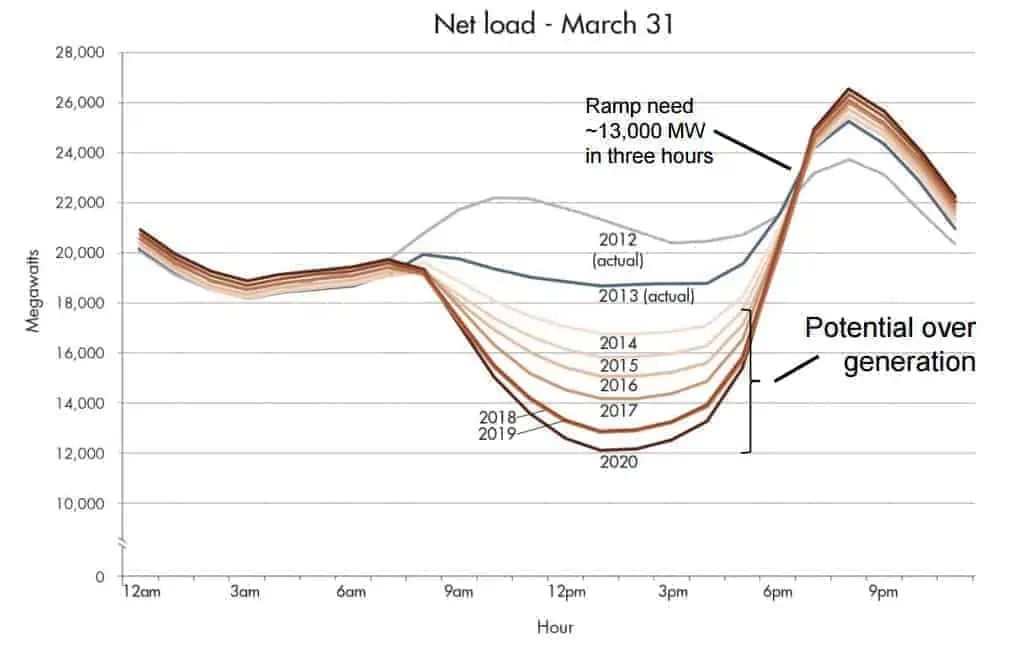
California's duck curve — net load dips with midday solar, then ramps steeply into the evening peak. Source: Aurora Solar, from CAISO data.
The interesting part is the other 80 GW that never touches this grid. It is off-grid village solar across 80,000 villages, each with its own 4 MWh battery (Reccessary, 2025; pv-magazine, 2026). That is the de-dieselization program in miniature, replacing expensive diesel plants with small, modular solar plus storage.
Why big ambitions beat none at all
The button was pressed at Gilimanuk, and the ambition behind it is real. The diesel economics alone justify chasing it: remote diesel power costs about Rp 3,650 per kWh in fuel alone, against a top tariff of about Rp 1,700 (The Inverter's diesel analysis, 2026). PLN loses about Rp 2,000 on every diesel kWh it sells. Replacing it with solar-plus-storage is the correct move to protect state budget.
Big ambitions also force things to move. The 2022 de-dieselization program stalled with zero PPAs signed (IEEFA, 2026). The launch turned 396.4 MWp into groundbreakings, and a 30 GW tender starts this year (ANTARA, 2026).
The risk was never the panels. The build rate is proven and the ambition is right. The question is whether the grid can take what follows — and that will be answered by the RUPTL rewrite and by whether PPAs actually get signed, not by press releases.