Why isn't every factory roof covered in solar panels?
A chocolate factory in Bandung installed 3.6 MW of rooftop solar. But why don't we see more Indonesian businesses doing the same?
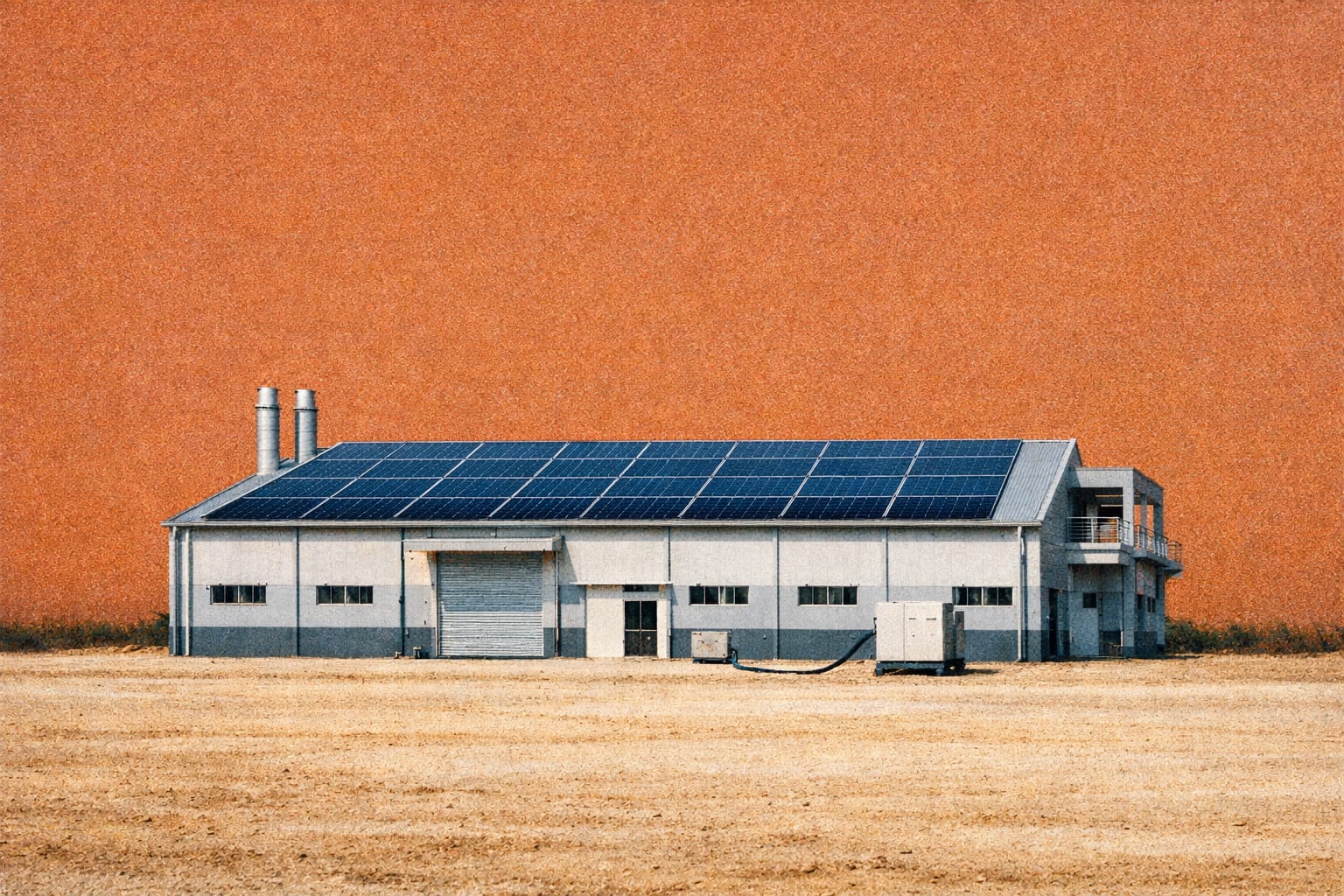
From above, the roof of PT Perusahaan Industri Ceres looks like it's wearing a metallic cloak. Thousands of photovoltaic panels stretch across the factory building, soaking up the equatorial sun. It's the kind of sight that makes for good drone footage (and even better press releases).
Ceres, a chocolate manufacturer under the Petra Food group, has just completed the second phase of a rooftop solar installation, bringing total capacity to 3.6 MWp. That makes it roughly the third-largest single-building rooftop solar installation in the country, after Coca-Cola Europacific Partners' 7.2 MWp in Bekasi and textile manufacturer Dhanar Mas Concern's 4.5 MWp in Banjaran (SolarQuarter, Jun 2026; CCEP Indonesia; Green Roof Asia).
One thing that makes the Ceres deal interesting is that they didn't pay anything upfront. Under a 15-year energy service agreement, TotalEnergies ENEOS (a joint venture between France's TotalEnergies and Japan's ENEOS) financed, built, and operates the entire system.
Ceres simply pays for the electricity it uses — at a discount below what it would pay state utility PLN. It's like renting a power plant, except the fuel (sunlight) is free.
The other benefit? A good image internationally. Would you say no to chocolate made with the sun's power?
Is this for cost savings or a PR stunt?
Indonesia has strong solar resources. It's equatorial — consistent sun, year-round. And yet by end-2025, the country had only ~600 MWp of rooftop solar total (TransitionZero, Feb 2026). For context, Vietnam, a similar-sized economy, passed 9 GW of rooftop solar by end-2020 alone (ASEAN Centre for Energy).
Let's start with the obvious question: does solar actually make economic sense for a factory? Yes, it does.
Solar module prices fell ~50% in 2024 alone (ResearchAndMarkets, Jan 2026). Actual market data puts turnkey cost at IDR 8.5–12 million/kWp (SolarCommercialIndo, Jun 2026) and Java's annual yield at ~1,400 kWh/kWp (Global Solar Atlas / World Bank, Solargis). Spread capex over 35,000 lifetime kWh (1,400/yr × 25 yrs) and you get roughly Rp 240–340/kWh if they pay for the panels alone.
If we then add estimated O&M (roughly 1% of capex per year (IRENA, 2025)) and one inverter replacement around year 12 (10% of system cost (BENY, 2026)), that real-world figure climbs to roughly Rp 330–500/kWh. For reference, IEEFA independently estimates utility-scale solar at USD 0.04–0.06/kWh (Rp 660–1,000/kWh) — a different segment (utility-scale, not rooftop), but the same direction: solar sits comfortably below the I-3 tariff (IEEFA, Apr 2026).
Meanwhile, a medium factory on PLN's I-3 tariff pays Rp 1,115/kWh. That's 55–70% in savings!
Ceres proves this isn't theoretical. Under a 15-year PPA with TotalEnergies ENEOS, the company pays a negotiated rate below PLN's tariff for every solar kWh generated (SolarQuarter, Jun 2026). The exact price is commercial confidentiality, but we can estimate based on what's public:
- Annual generation: ~5,040 MWh (3.6 MWp × 1,400 kWh/kWp)
- Saving per kWh: ~Rp 115 (assuming PPA at ~Rp 1,000/kWh vs PLN I-3 tariff of Rp 1,115/kWh, a 10% savings)
- Annual savings at full self-consumption: ~Rp 580 million
- Realistic figure (adjusting for 25% weekend/holiday waste): Rp 435 million/year
This isn't PR or greenwashing. It's a chocolate factory saving nearly half a billion rupiah a year by signing a contract and letting someone else put panels on their roof.
So why isn't every factory doing it?
Two reasons — and they compound each other.
First, the economics. Indonesia's electricity tariff structure makes solar less attractive than it should be. Take a look:
| Customer class | Tariff (Rp/kWh) |
|---|---|
| I-4 (large industry, >30,000 kVA) | 997 |
| I-3 (medium industry, >200 kVA) | 1,115 |
| P-1 (public/office, >200 kVA) | 1,444 |
| R-1 (residential 1,300–2,200 VA) | 1,445 |
| R-1 (residential 900 VA, non-subsidi) | 1,352 |
| R-1 (residential 450 VA, subsidi) | 415 |
Sources: Detik Sulsel, May 2026; SunEnergy; Kompas, Jun 2026
Notice something odd? Industrial customers pay less than households. In Indonesia, a factory consuming 30,000 kVA pays the second-cheapest rate in the country — only above subsidized 450 VA households.
This cross-subsidy was likely designed to encourage industrialization. But the side effect is brutal: it makes self-generated solar economically unattractive for most factories. Solar has to beat an artificially low industrial tariff, not a market rate.
Second, the policy. Even when the economics pencil out, the system doesn't let factories act on it.
Under MEMR Regulation No. 2/2024, new rooftop solar installations cannot export excess power to the grid (ABNR Law, Apr 2024). Net metering — the ability to sell surplus daytime power back — has been abolished. The stated reasons are grid reliability and stability. In the eyes of the state utility, independent generation and distribution might be too disruptive.
This means factories must size their systems to never export — designing for minimum daytime load rather than maximum roof potential.
And here's where it gets interesting: you can't even share solar with your neighbor. Under Indonesia's Electricity Law (Law No. 30/2009), the moment electricity crosses from your meter to someone else's, it becomes public supply — and that requires an IUPTLU license (Pasal 19(2)) that's effectively reserved for PLN. Do it without one? Up to 3 years in prison and Rp 2 billion in fines (Pasal 49(1)).
PLN isn't anti-solar. They do allow some rooftop export — a 5,746 MW national quota for 2024–2028 divided by region keeps the door open (Energy Trend, Jul 2024). The state energy plan (RUPTL) mandates PLN to develop 100 GW of solar capacity. But there's a condition: PLN wants the solar it can control — large utility-scale farms under PPA, not distributed rooftop on every factory roof.
President Prabowo has explicitly rejected power wheeling, keeping PLN's monopoly intact (Petromindo, Feb 2025). Every kWh a factory self-generates is lost retail revenue — and IESR simulations show that just 1 GWp of rooftop solar reduces PLN's income by ~0.58% (IESR, Jul 2021).
How does Ceres make it work?
The panels are on Ceres' own roof. The electricity is for Ceres' own consumption. TotalEnergies ENEOS structured the deal as an energy service agreement, not a direct sale of electricity — a fine legal distinction that keeps it outside PLN's monopoly (TotalEnergies ENEOS FAQ).
But it's not just a clever contract. As a 3.6 MWp system connected to PLN's grid, it still required an Izin Operasi, a Sertifikat Laik Operasi (SLO), and approval under the quota system. The real trick is that none of this involves crossing a customer boundary. The electricity never becomes "public supply".
However, things might get legally complicated if TotalEnergies owned a separate piece of land, built a solar farm, and wired it across to Ceres — even if they were side by side. It's one of those legal things that seems to make no sense sometimes. But for Ceres, it means ~Rp 435 million in annual savings, a green PR halo, and zero upfront investment.
Policy is the bottleneck
So why isn't every factory roof covered?
The economics work — solar is cheaper than PLN. Ceres proved it can be done. But the system wasn't designed for it.
Industrial tariffs are kept artificially low through cross-subsidy, making the solar hurdle higher than physics would suggest. Net metering is gone, so factories can't export surplus power. Quotas cap how much rooftop can interconnect. And the law treats selling a watt to your neighbor the same as running an unlicensed utility — up to 3 years in prison.
The Ceres case proves rooftop solar can work for Indonesian factories. But the policy framework that made Ceres possible is narrower than the market would need for wider adoption.